



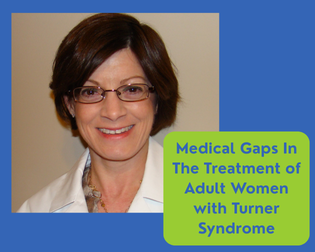

I am both a retired pediatric endocrinologist and a woman with Turner syndrome (TS). I have been a pediatric endocrinologist since 2000, and enjoy interacting with other girls and women with TS. My personal medical journey and pediatric endocrinology training have given me a unique perspective in the ongoing knowledge of Turner syndrome management.
My Turner Syndrome Journey
My journey with TS began when I was diagnosed with Turner syndrome at the age of 2 years. My pediatrician at that time noticed that I was falling off the growth curve. He referred me to a pediatric endocrinologist for further evaluation, who diagnosed me with TS by a karyotype (chromosome analysis). A diagnosis of hypothyroidism was added when I was 4 years of age, with thyroid medication initiated.
At the age of 9 years, I was placed on cadaveric growth hormone. I was then changed to synthetic growth hormone once it became available in 1985. From 1985 to 1989, I was part of several pilot studies, including using growth hormone only and growth hormone plus oxandrolone.
After completing growth hormone, I was placed on hormonal replacement therapy. I reached a final adult height of 4’8.” Although this is the average height of an untreated girl with TS, I received the utmost in medical care during my childhood by pediatricians and pediatric endocrinologists for the time period. This included treatment for multiple ear infections and urinary tract infections and continued management of my hypothyroidism.
Care Experiences in Adulthood

However, since graduating from the offices of both my pediatrician and my pediatric endocrinologist, I have very much felt left on my own for appropriate medical care. As an adult, I have experienced many additional medical issues related to TS.
I experienced hearing loss and the need for hearing aids by my forties. Hearing aids were not covered by insurance, and it resulted in a significant cost. Around the same time, I experienced a recurrence of lymphedema with few lymphatic treatments available other than massage.
I have also had treatment for osteoporosis. This is not unexpected in an adult woman with TS. However, fine-tuning the diagnosis with accurate bone densities and scoring (TS women require using Z-scores instead of T-scores due to their unusual age and height discrepancy). My treatment has required finding a physician knowledgeable in the treatment of osteoporosis in TS. During my workup for osteoporosis treatment options, there was an unusual finding in my evaluation of a very low phosphorus level that has been determined as unrelated to my nutrition, metabolism, or kidney function. Although low phosphorus levels are not known to be associated with TS, little information is available to date.
Now in my 50’s, I have had a tooth extraction, sinus augmentation, and tooth implant placement following the loss of a tooth due to resorption, likely as a result of years with braces combined with having short roots commonly seen in TS. This is not an uncommon dental procedure. However, receiving sedation was not an option, as the anesthesiologist involved was unfamiliar with TS. Even though I am an older adult woman with normal airways, my small size and weight of only 80 pounds made the anesthesiologist afraid to use sedation.
In addition, I am now 55 years of age and at the recommended time of discontinuing my hormonal replacement—but without clear instructions from the medical literature on the most appropriate way.
The Gaps in Care for TS Women
All of these medical issues that I have faced as an adult woman with TS have left me feeling discouraged and isolated. Often I have had to make the decision on my own medical care due to the lack of knowledge in the medical community on managing TS in adulthood.
Although the pediatric medical community has a long way to go in increasing information and awareness for treating girls with TS, there continues to be very little information on the care of adult women with TS. Huge gaps exist.
These gaps include handling anesthesia, dental care, heart health, osteoporosis, hearing loss, and when and how to discontinue hormonal replacement in TS adult women. And that doesn’t even include the health insurance issues! It is very disheartening as a TS adult to have to navigate my own medical care.
My desire is that the adult medical community will heed this medical gap awareness and take on the torch of medical care for adult women with TS. That way, the transition from childhood to adulthood for TS girls will be far smoother and hopeful than it is today.
Until then, women with TS must be their own best advocate for medical care. I would encourage all parents of girls with TS to teach their girls to be their own advocates in the pursuit of appropriate treatments as early as possible. This may mean providing TS resources to their physicians and searching for physicians knowledgeable in the care of adult women with TS.
RESOURCES
Written by Mary Gwyn Roper, MD Medical Advisor Liaison, Trustee, Professional Member, TS Women in Medicine

Thank you for sharing your story. I have a question about my 27 year old daughter with TS. How do you know if you are getting the correct amount of estrogen through hormone replacement? She is on the birth control pill and has gained a lot of weight lately. I know you can’t give medical advice but any thoughts?