





Turner syndrome (TS) can have varying degrees of impact on one’s education through both potential learning and physical disabilities. These may include social cognition, ADHD or ADD, math abilities, and visuospatial organization.
Often girls with Turner syndrome and their families have to engage in self-advocacy within schools and healthcare to get the care and accommodations they need to thrive. However, this can be intimidating and inefficient.
Not to mention, over a third of girls diagnosed with TS are already in a school setting. This further signifies the importance for collaboration between the guardians, educators, and healthcare professionals when addressing the psychosocial and educational needs of the child.
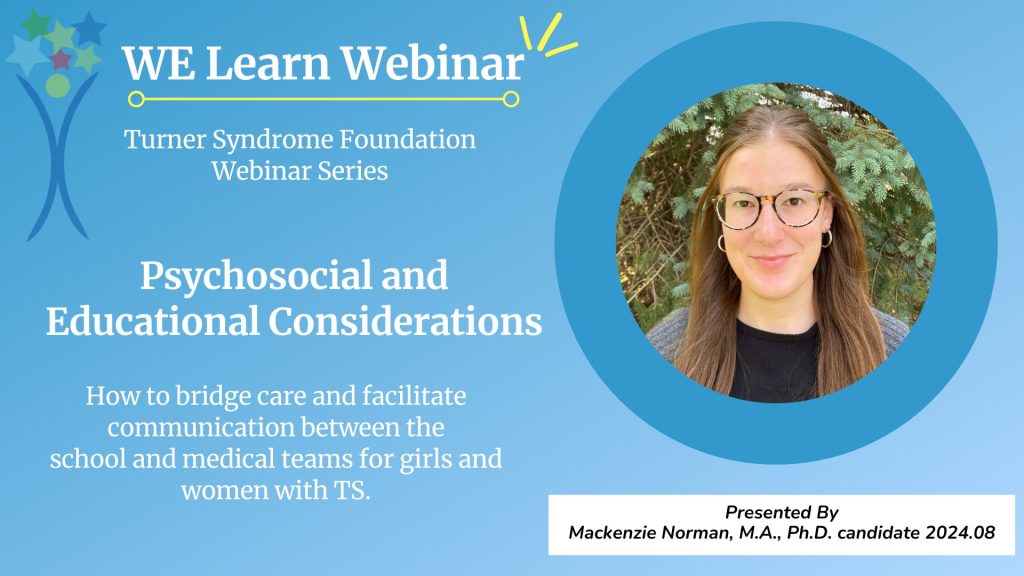
The webinar, Psychosocial and Educational Considerations; How to Bridge Care and Facilitate Communication Between the Schools and Medical Teams for Girls and Women with TS, focuses on interventions that can be made by healthcare providers and educators to support individuals with Turner syndrome through bridging communications.
Presented on July 16, 2024 at 8pm EDT, attending this event is necessary to learn more about strategies for strengthening the support systems for girls and women with TS.
The host, Mackenzie Norman, a PHD candidate in School Psychology at Michigan State University, has an interest in educational and psychosocial interventions for those with TS. Norman published an article in 2022 providing recommendations for evidence-based interventions, relevant literature, and screenings for school psychologists and educators working with students with TS. Moreover, She is completing her clinical internship at Oregon Health & Science University specializing in pediatric psychology.
Her expertise is remarkable for the topic at hand. Don’t miss your opportunity to join!
Register Here or by clicking the image on top!
Subscribe to our Newsletter

Hi, My name is Diane and I was diagnosed with TS at age 16. At that time, I was given all the appropriate medical interventions that were available at the time. However, the psychosocial ramifications of TS were virtually unknown at the time, I was perceived as “different” and had a tough time fitting in socially. I wish it had been possible to have received appropriate counseling and medication. For example, after years of experiencing difficulty with organization, completing tasks on time, and experiencing inappropriate outbursts from time to time, Eventually, as a mid-career adult, I was diagnosed with ADHD and prescribed Adderall. The proper medication was a total game-changer for me. At this point in my life, I look forward to learning as much as possible about the psychosocial aspects of TS so if I find myself in a position to help other young women with TS, I will be equipped to do so.