



The 2025 Petition for Turner Syndrome and Why it Matters
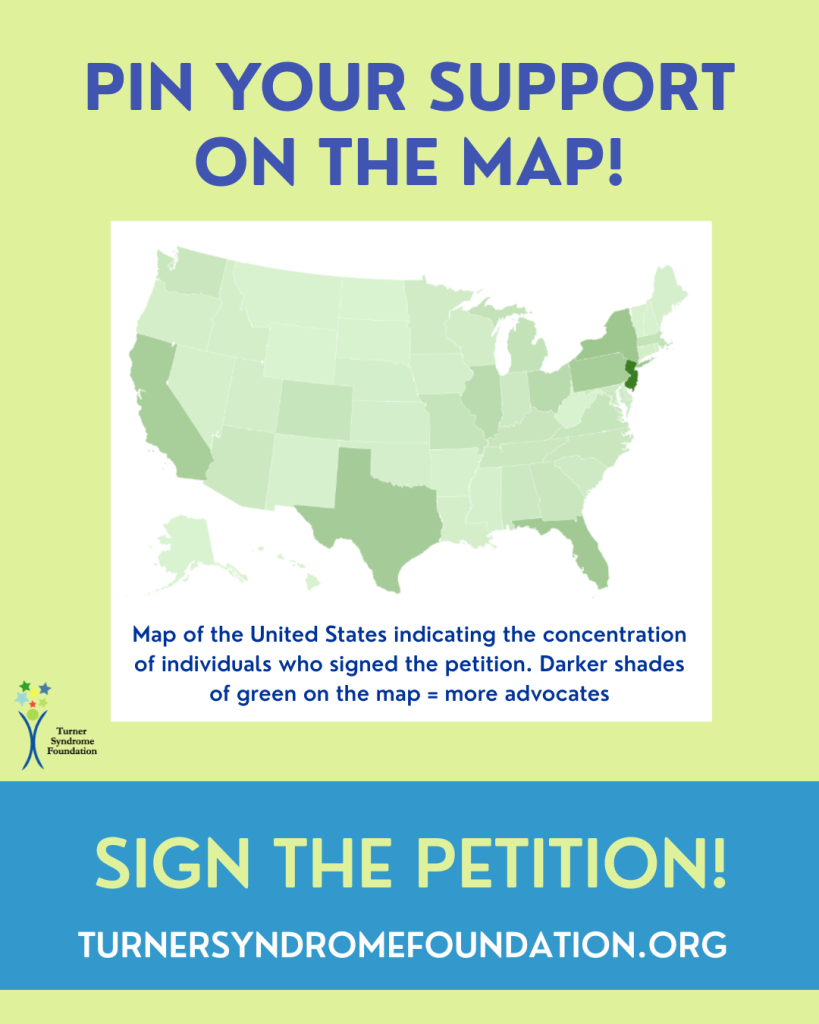
We’re thrilled to see that nearly 200 people have signed the Turner Syndrome Foundation’s Petition for Patient Care so far in 2025! While the majority of the signatures came from within the United States, we’re excited that we also had support from Cameroon, Canada, and England. This proves we are making positive strides in increasing Turner syndrome (TS) awareness around the world, but there is still work to be done and it begins with each of us!
When more individuals join us in signing the petition, this builds momentum which is key to awareness and advocacy. Signatures from outside of the United States show a global impact that advocacy can make. This in turn makes patients feel seen and heard.
Advocacy and awareness on a national and global level also empowers patients to advocate for themselves in various situations such as in the doctor’s office, at school, or in the workplace. For example, not every provider knows about the condition, guidelines, and unique needs which leads to patients ending up feeling like they have to teach doctors about TS.
The included infographic shows states within the US that have signatures already. This is often because just one person within that state shared the petition on social media or with their close friends and family, and they brought in a whole new cohort of supporters to the cause!
Is your state represented? Can you help add more states? It’s never too late to add your signature and represent your state! Be sure to share it with others as well, so we can make the most impact possible.
Remember, friends, family, and other associates are welcome to sign in support as well. You can find the petition at this link that can also be shared on social media if you’d like to create even more awareness and advocacy.
Lessons Learned from the Petition
We have gathered some important information about the TS community through the petition responses. Among the signatures, 32% were individuals with TS themselves, 55% were family members, 11% were a friend, and 2% indicated having no connection to TS.
From this data we can see that people without a diagnosis of TS themselves outnumbered TS patients! This is the power of sharing the petition and asking others to get involved. If just TS patients carry the burden of advocacy we cannot alone move the needle, but if others get involved, we can make a greater impact!

In addition, within the petition, we asked TS patients to share their top concerns so we can gain a greater understanding of the community’s needs. Among the top concerns include medical care, research, and awareness, while less common, but still relevant, concerns include workplace rights, legislation, insurance, financial, family planning, education, and caregiver support.
With this information, we can better understand how we can support the TS community and advocate for policies that will make the most impact in their lives.
Legislative advocacy in a nutshell. What good does it do?

Meet Legislative Advocacy Committee member, Bridget Malone. She worked towards having a TS proclamation signed in the state of New York. While it started with an email, the difficulty was in finding a state senator who was receptive and jumped on board, but TS patients know all about overcoming challenges. Bridget adds, “the key is just getting started with a phone call or email.”
Proclamations are a perfect first step into advocacy. While often easier to achieve for a few reasons, one of the main reasons is that this is not asking for money.
Proclamations are different from bills or laws in that they’re symbolic as well as not up for debate or vote. Bills or laws tend to be a more in-depth process, even if they don’t require being renewed like proclamations.
They are essentially a signed statement that makes a public declaration, often a day or month of recognition. A day, week, or month of recognition can bring awareness to our causes or needs going forward. This is a critical first step in achieving further action.
What Can You Do Next?
If this idea interests or intrigues you, the Turner Syndrome Foundation has some information about advocacy in general at this link. More information, as well as the Volunteer Application, can be found at this link. We’d love to hear from you and talk more about how we can work together!
Written by Helen Rhoads, Kaitlin Yasika, Bridget Malone, Advocacy Committee Members. Designed by Delvis Rodriguez, Data Management. Cover Graphic by Kesha Amin, TSF volunteer graphic designer.
© Turner Syndrome Foundation, 2025