



Research is critical to advancing the understanding of Turner syndrome, and successful research requires participation from those living with the condition. In this blog, learn about a new research study you can participate in to help a Doctoral candidate and woman with TS generate more knowledge about social skills in Turner syndrome.
About the Researcher

Hello! My name is McKenna Fleming. I am 22 years old, and I was diagnosed with Turner syndrome in 2019, when I was 15 years old. I am currently in a Doctorate program to become an occupational therapist, and am partnering with the Turner Syndrome Foundation to complete my capstone research project.
I am researching the lived experiences of individuals with Turner syndrome and social skills challenges. I am also investigating the effectiveness of a four-part virtual social skills training to improve knowledge of the factors that contribute to social skills challenges, and knowledge of research-based strategies to help.
Social Skills and Turner Syndrome
Individuals with Turner Syndrome are at increased risk for experiencing social skills challenges (Hutaff-Lee et al.; 2020, NORD, 2023). This is something I personally have struggled with, and something I’m sure many of my fellow Turner syndrome butterflies can relate to.
One definition of social skills is “a set of learned abilities that enable an individual to interact competently and appropriately in a given social context” (American Psychological Association, n.d., p.1). Social interaction involves several complex processes, include initiating and terminating the interaction, shaping the content of the interaction, physically and verbally supporting the interaction, and adapting the interaction (American Occupational Therapy Association [AOTA], 2020).
Researchers have tried to find out why people with Turner Syndrome are more likely to experience social challenges. Three specific factors will be the focus of this study: higher levels of alexithymia, difficulty with theory of mind, and difficulty with executive functioning skills. Individuals with Turner Syndrome are more likely to experience each of these challenges (Jordan et al., 2023; Lepage et al., 2013; Roelofs et al., 2015). I’ll summarize them below.
Alexithymia
Alexithymia is characterized by difficulty recognizing and describing emotions, both your own emotions, and those of others (Roelofs et al., 2015). This may impact social interaction due to incorrect interpretations of another’s emotions, causing delayed or improper emotional reactions. Improper reactions may lead to peers distancing themselves from the individual with Turner syndrome, contributing to social isolation.
Theory of Mind
Theory of mind is described as the ability to understand another individual’s perspective, to infer what they are thinking (Jordan et al., 2023). Difficulty understanding others’ perspectives may come across as socially undesirable behavior. The result of this could be peers distancing themselves, contributing to social isolation.
Executive Functioning
Executive functioning includes skills such as inhibition, flexibility, emotional control, initiation, working memory, planning and organization, and self-monitoring of behavior (Jordan et al., 2023; Lepage et al., 2013). If someone struggles to plan outings with peers, organize their schedule, or demonstrate appropriate inhibition and emotional control, this may lead to peers becoming frustrated. The result of this frustration may be peers distancing themselves, contributing to social isolation.
Why Research This Topic?
When I was considering what I wanted to research for my capstone project, I knew that it had to be something that was personal and meaningful to me, because I would be spending a significant amount of time on it. One of the biggest day-to-day challenges I face as a woman with Turner syndrome is difficulty with socialization, and I know that this is a common experience. So, I selected social skills as the topic of my capstone project.
My Story
Beginning around third or fourth grade, I began noticing that there was something different about me from my peers, but I couldn’t quite put my finger on it. It seemed that I was always on the outside of things. It felt as though I was tagging along, instead of truly being part of the group. When I moved up to middle school, things only got worse. My friends began to ignore me. I couldn’t relate to the things they were talking about, and I had a hard time thinking of things to say. When I attempted to engage in conversation with them, they would answer my question, but then turn away and continue talking amongst themselves. I didn’t have the self-confidence or social skills to find a new friend group.
In eighth grade, I earned a spot on the audition-only dance company at my studio. This was helpful because it was a different group of people than those I saw at school every day, and they were kinder to me. Even so, I still had the same feeling of being on the outside looking in, rather than being part of the group. This feeling stuck with me all the way throughout school.
Even in college and graduate school, I had a hard time interacting with people and initiating friendships and social interactions. With my study, I hope to help fellow young adults with Turner syndrome develop their knowledge and confidence in order to improve their social skills.
Participants Needed!
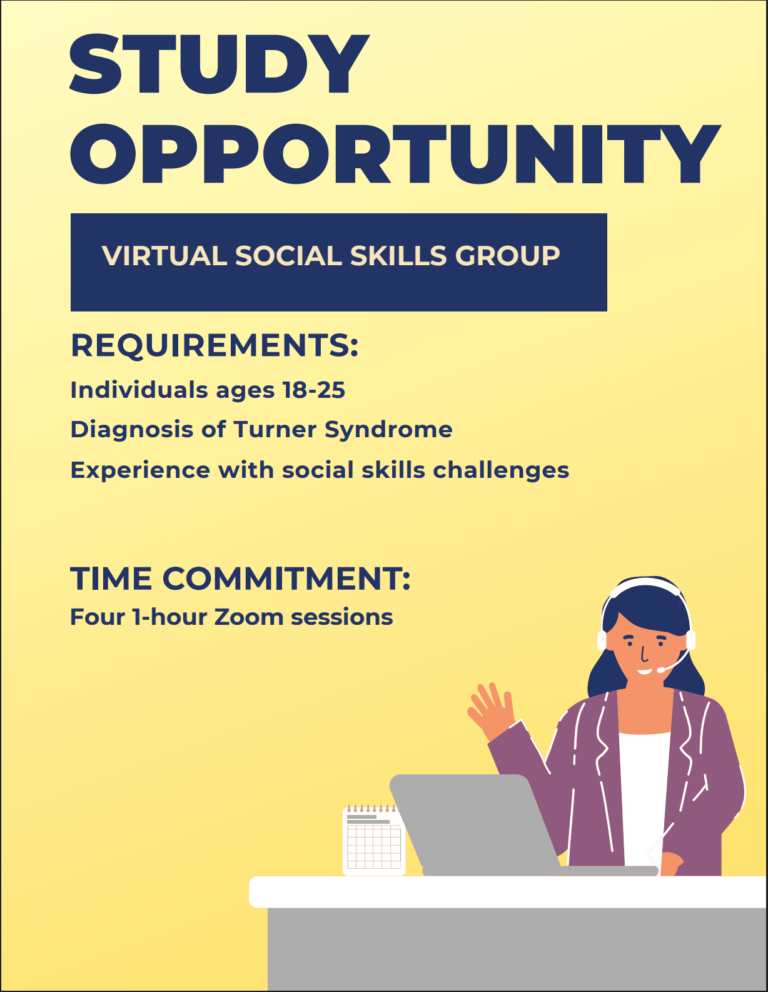
I encourage all of my fellow Turner syndrome butterflies between the ages of 18 and 25 to participate in this research study. Applications to participate must be submitted by January 31st.
The time commitment is four 1-hour Zoom sessions, plus a pre- and post-survey. The dates of the sessions are February 3rd, February 17th, March 3rd, and March 17th all at 8pm EST.
I believe that by participating, you can gain knowledge of the factors that may be leading to your social skills challenges, and what you can do about them.
Also, your participation will be instrumental in helping a fellow Turner syndrome butterfly earn her Doctorate! I hope you will feel confident contributing to this endeavor. I hope that you will feel supported and encouraged throughout this experience, and walk away with valuable new knowledge.
References
American Occupational Therapy Association. (2020). Occupational therapy practice framework: Domain and process. (4th ed.). American Journal of Occupational Therapy, 74(Suppl. 2).
American Psychological Association. (n.d.). APA dictionary of psychology.
Hutaff-Lee, C., Bennett, E., Howell, S., & Tartaglia, N. (2019). Clinical developmental, neuropsychological, and social-emotional features of Turner syndrome. American Journal of Medical Genetics,181(1), 126–134.
Jordan, T. L., Klabunde, M., Green, T., Hong, D. S., Ross, J. L., Jo, B., & Reiss, A. L. (2023). Longitudinal investigation of cognition, social competence, and anxiety in children and adolescents with Turner syndrome. Hormones and Behavior, 149.
Lepage, J.-F., Dunkin, B., Hong, D. S., & Reiss, A. L. (2013). Impact of cognitive profile on social functioning in prepubescent females with Turner syndrome. Child Neuropsychology, 19(2), 161–172.
National Organization for Rare Disorders (2023). Turner Syndrome.
Roelofs, R. L., Wingbermühle, E., Freriks, K., Verhaak, C. M., Kessels, R. P. C., & Egger, J. I. M. (2015). Alexithymia, emotion perception, and social assertiveness in adult women with Noonan and Turner syndromes. American Journal of Medical Genetics Part A, 167(4), 768–776.
Written by McKenna Fleming, TSF Researcher/Blog Writer, Occupational Therapy Student, and designed by Gerely Caba.
© Turner Syndrome Foundation, 2026