



Navigating Healthcare with Turner Syndrome
Navigating the healthcare system can be confusing and frustrating—even more so when living with a genetic condition like Turner syndrome (TS). As someone with TS, I’ve often walked into doctors appointments only to discover the provider has little to no knowledge of the condition. These moments can leave you feeling unseen, misunderstood, and uncertain about whether you’re receiving the care you truly need.
Over time, I’ve learned how essential it is to build a trusted medical team—one that listens, learns, and provides care tailored to the unique needs of women with TS. This journey has inspired a deep passion in me for improving healthcare access and advocating for those with Turner syndrome.
Through this blog, I hope to share helpful strategies for finding informed, compassionate doctors and tips for confidently advocating for your health. You are not alone, and you deserve care that understands and supports you every step of the way.
Tips for Finding Providers
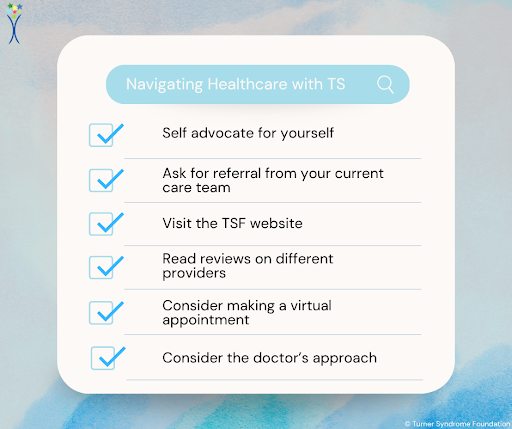
1. Ask for referrals from your current care team. You can stress that you want to see someone knowledgeable about Turner syndrome so when you go see your new providers you feel as if you are getting the best personalized care. For example, asking your primary doctor for a referral for a cardiologist who specializes in TS.
2. The TS foundation provides many resources for finding doctors that understand and are knowledgeable in TS. It includes care guidelines and providers organized by state. You can also recommend a provider you have found for other TS patients to access. Click below to check out all of the resources we offer.
3. It can also be beneficial to read reviews on different providers. Websites such as Healthgrades and MediFind provide access to provider reviews by searching a name, condition, or area.
4. Consider making a virtual appointment. This can improve accessibility to doctors who have experience with TS, and can potentially allow for a wider range of appointment times that work for both you and the doctor. This option also helps cut down commute times and reduce transportation barriers.
5. Consider the doctor’s approach. Do you prefer a provider who is more holistic, a provider who is collaborative, a provider who just tells you what to do, etc. Finding a provider who aligns with your values can increase the trust built and your care will be more personalized to you.
Self-Advocacy as a Patient
The most important thing you can do as a patient or caregiver of a child with TS is to advocate for yourself in appointments. The best way to do this is by showing up prepared with symptoms, medical history, and questions to ask. By doing this, you can assure that you get all the information you need and receive proper care.
If you see a provider who is unsure about TS, you can point them towards the Clinical Care Guidelines for girls and women with TS. If you can, you can bring a support system to help advocate for you, take notes, and ask questions. This can help you make the most of the appointment and avoid information overwhelm.
Remember, if you feel that your doctor is being dismissive or uncommunicative, you can ask for your medical records and find a doctor who is the right fit for you. Finding a doctor who will be a partner in care is critical, and sometimes that means trying out different providers to find the right fit.
My Experience Transitioning from Pediatric to Adult Care

In my personal experience, transitioning from pediatric to adult care was challenging. When I left my pediatric care team, I didn’t realize how much I didn’t know about managing my own health.
I assumed adult doctors would automatically know what I needed, but many weren’t familiar with TS. I didn’t know which specialists to see or how often—cardiology, audiology, endocrinology, OB/GYN? I was unsure who managed what, especially when it came to hormone therapy.
Because of that confusion, I sometimes went without estrogen and progesterone. College made things even harder. Moving states meant starting over with new doctors, new clinics, and having to explain TS over and over.
Looking back, I wish I’d asked more questions before aging out of pediatric care. If you’re getting close to that transition, I recommend meeting with your care team and asking for a clear plan:
- What doctors should I see and how often?
- Who handles hormone therapy?
- What tests do I need regularly?
Having those answers in writing can make a big difference. You’ll be better prepared to advocate for yourself and keep your care on track, no matter where life takes you.
You’re not alone. And with the right tools, you can take control of your care.
Further Reading:
Written by Calla Norton, TSF Volunteer Blog Writer. Designed by Delvis Rodriguez, Digital Marketing Coordinator
© Turner Syndrome Foundation, 2025