



Turner syndrome (TS) is a genetic disorder and individuals with TS may have an increased risk of certain health conditions, including some cancers. While TS itself does not cause cancer, associated hormonal and genetic factors may contribute to an increased risk. The impact of Turner syndrome on several types of cancer risk will be explored in this article.
What is Cancer?
Cancer is a disease caused by the uncontrolled growth of cells in the body, which can form lumps of tissues known as ‘tumors.’ These tumors can be benign, meaning they don’t spread, or malignant, meaning they may metastasize to other areas of the body (What Is Cancer?, 2021). It is important to note that benign tumors can also be harmful if they grow to a size that impacts nearby organs, and thus many are removed early in development with surgery (What Is Cancer?, 2021).
Cancer Risk Factors
From (Cancer Risk Factors, 2024) and (World Health Organization: WHO, 2022)
- Alcohol consumption
- Family history
- Human papillomavirus
- Obesity
- Tobacco use
- Air pollution
- Exposure to carcinogens
- Hepatitis
Genetics also plays an outsized role in cancer development and metastasis (spread), as cancer begins with changes in genes that control how cells grow and multiply, and tumor growth is facilitated by mutations that enable cancerous cells to evade normal cellular signals for cell death or growth control (The Genetics of Cancer, 2024). This means that a genetic condition like Turner syndrome has the potential to greatly affect a TS patient’s cancer risk, although this change can vary between individuals and various types of cancer.
Skin Cancer
Skin cancer is the abnormal growth of skin cells, often due to exposure to sunlight (Skin Cancer – Symptoms and Causes, n.d.). There are three major kinds of skin cancer, each with their own presentations.
Basal Cell Carcinoma
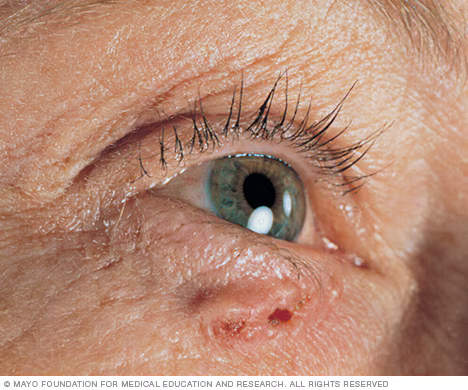
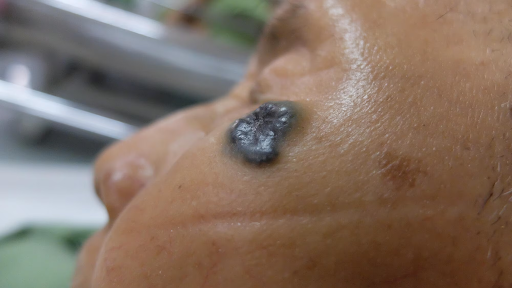
Basal cell carcinoma is likely to appear on sun-exposed areas of the body such as the neck and face (Skin Cancer – Symptoms and Causes, n.d.). It presents differently on lighter and darker skin, but generally appears as shown in the images below:
On white skin ((Basal Cell Carcinoma – Symptoms & Causes – Mayo Clinic, 2021):
On brown skin (Basal Cell Carcinoma – Symptoms & Causes – Mayo Clinic, 2021):
Squamous Cell Carcinoma
Squamous cell carcinoma also occurs in sun-exposed areas, but people with darker skin are more likely to develop it in areas that are not exposed to sunlight (Skin Cancer – Symptoms and Causes, n.d.). They generally present as a firm, red nodule or a scaly, crusted lesion (Skin Cancer – Symptoms and Causes, n.d.).
Melanoma
Melanoma can develop on normal skin, or develop from melanocytic nevi, more commonly known as moles (Skin Cancer – Symptoms and Causes, n.d.). The signs of melanoma include changes in shape, size, or feel of a mole, bleeding from a mole, painful or irregularly colored lesions, or dark lesions on the palms, soles, fingertips or toes, as well as on mucous membranes in the mouth, nose, vagina, or anus (Skin Cancer – Symptoms and Causes, n.d.).
Turner syndrome increases the incidence of melanocytic nevi, likely due to the abnormal hormone balances experienced by TS patients (Friedman, 2024). It is theorized that the higher incidence of melanocytic nevi could be linked to higher incidence of melanoma for TS patients, but the evidence for this is mixed, and further research is required to properly quantify this relationship (Clabbers et al., 2023). However, hormonal influence is also a factor, as a small study of 61 TS patients found that the use of growth hormone therapy correlated to a higher risk of melanocytic nevi developing into melanoma (Heymann, 2024).
Unfortunately, very little research is available on the risk of other kinds of skin cancer associated with Turner Syndrome, identifying this as a potential area of focus for future studies.
Central Nervous System (CNS) Tumors
CNS tumors are tumors that form in the tissues of the brain or spinal cord (Adult Central Nervous System Tumors Treatment, 2024). Given the delicate nature of their location, both benign and malignant CNS tumors require treatment as they can press onto areas of the brain, impeding important functions or even causing cognitive impairment (Adult Central Nervous System Tumors Treatment, 2024).
Symptoms (JohnsHopkins Medicine, n.d.)
- Headaches
- Seizures or convulsions
- Difficulty thinking, speaking or finding words
- Personality or behavior changes
- Weakness, numbness or paralysis in one part or one side of the body
- Loss of balance, dizziness or unsteadiness
- Loss of hearing
- Vision changes
- Confusion and disorientation
- Memory loss
A study of Turner syndrome patients in Great Britain demonstrated that TS patients carry a slightly increased risk for CNS tumors, mainly tumors of the meninges (Schoemaker et al., 2008). Known as meningiomas, these tumors arise from the meninges, which are the membranes that surround the brain and spinal cord (PennMedicine, n.d.). They are the most common kind of head tumor and may compress adjacent areas of the brain, as well as important nerves or blood vessels (PennMedicine, n.d.). It has been theorized that this increased risk in TS patients could be related to hormone replacement therapy, since meningiomas have been found to have receptors for specific growth and sex hormones.
Bladder and Urethra Cancer
Bladder and Urethral cancers, as the name suggests, are cancers formed by cells in the bladder and urethra (Schoemaker et al., 2008).
Symptoms (Bladder Cancer – Symptoms and Causes, n.d.)
- Blood in urine (hematuria), which may cause urine to appear bright red or cola colored, though sometimes the urine appears normal and blood is detected on a lab test
- Frequent urination
- Painful urination
- Back pain
The study of TS patients in Great Britain uncovered a slightly increased risk of bladder and urethra cancer (Schoemaker et al., 2008). The most likely cause for this is the increased frequency of urinary tract infections (UTIs) in TS patients, which result from a slightly different bladder structure (Turner Syndrome Foundation, 2024).
Corpus Uteri (Endometrial) Cancer
Corpus uteri, otherwise known as endometrial, cancer is found in the cells lining the inside of the uterus (Endometrial Cancer – Symptoms and Causes, n.d.).
Symptoms (Endometrial Cancer – Symptoms and Causes, n.d.):
- Vaginal bleeding after menopause
- Bleeding between periods
- Pelvic pain
Corpus uteri cancer is known to have an elevated risk in women ages 15-44, likely due to the constant refreshing of the endometrial cells during menstruation (Schoemaker et al., 2008). It has also been noted that there may be a slight correlation between hormone replacement therapy and corpus uteri cancer risk, though further research is required to confirm this (Schoemaker et al., 2008).
Neuroblastoma
Neuroblastoma is a cancer formed from immature nerve tissues known as ‘neuroblasts’ (National Library of Medicine, n.d.). These tumors usually form in the adrenal glands, which are found on top of the kidneys and control heart rate, blood pressure, blood glucose, and other stress responses (National Library of Medicine, n.d.).
Symptoms (Neuroblastoma – Symptoms and Causes, n.d.)
- Neuroblastoma in the abdomen — the most common form — may cause signs and symptoms such as:
- Abdominal pain
- A mass under the skin that isn’t tender when touched
- Changes in bowel habits, such as diarrhea or constipation
- Neuroblastoma in the chest may cause signs and symptoms such as:
- Wheezing
- Chest pain
- Changes to the eyes, including drooping eyelids and unequal pupil size
- Other signs and symptoms that may indicate neuroblastoma include:
- Lumps of tissue under the skin
- Eyeballs that seem to protrude from the sockets (proptosis)
- Dark circles, similar to bruises, around the eyes
- Back pain
- Fever
- Unexplained weight loss
- Bone pain
It has been found that children and adolescents with Turner syndrome may be slightly predisposed to neuroblastomas, but screening of urine for high levels of a metabolite known as catecholamine may indicate the presence of these tumors (Blatt et al., 1997).
What about Hormone Replacement Therapy?
Overall, hormone replacement therapy specifically in TS patients has no confirmed or medically accepted relationship with an increased risk of cancer (Viuff et al., 2020). This is likely because HRT in TS patients normally serves to make up for the lower levels of certain hormones that result from the TS mutation.
What can you do?
While the increased risks of certain cancers associated with TS may seem daunting, there are many steps patients and their families can take to stay vigilant.
Overall cancer prevention tips (7 Healthy Habits That Can Lower Your Risk of Cancer, n.d.):
- Avoid the risk factors listed earlier in the article
- Limit time spent in the sun or use sunscreen
- Get vaccinated for HPV and Hepatitis B
- Practice safe sex and don’t share needles
- Get regularly screened by medical professionals for cancers that can be detected early.
- Skin, colon, cervix, and breast (can even be self-examined)
TS patients in particular may want to mention specific cancers that they may be at higher risk for to their doctors, in case there are additional screening options available. Screening is especially important because the early detection of any kind of cancer greatly increases the likelihood of successful treatment.
For some of the cancers mentioned in this article, there are specific screenings that a doctor may recommend. For skin cancer, it is advisable to report any changes to the skin that appear abnormal or painful to a doctor, who can recommend a biopsy of the area to confirm a diagnosis (Skin Cancer – Diagnosis and Treatment – Mayo Clinic, n.d.). Meningioma and CNS tumors can be screened for with an MRI or CT scan, though a neurologist or other recommended specialist should be consulted first (Diagnosis, n.d.). There are also many options for bladder or urethra cancer screening that a doctor may recommend.These include hematuria test, urine cytology, urine tumor marker test, and cystoscopy (Bladder Cancer Screening, 2023).
Ultimately, the best way to protect yourself from cancer, regardless of any elevated genetic predisposition, is to avoid the risk factors, get screened regularly, and consult with your general practitioner about any unexplainable symptoms you may be experiencing. With their knowledge of your medical history, they will be the most qualified to recommend further screenings and next steps.
Written by Nadia Kim, TSF volunteer blog writer. Designed by Delvis Rodriguez, Data Management. Cover Graphic by Kesha Amin, TSF volunteer graphic designer. Peer Reviewed by Mary Gwyn Roper, MD and Kayla Ganger, PA-C.
© Turner Syndrome Foundation, 2025



My sister has turners and has been recently diagnosed with lgl-tcell leukemia and has stage 4 osteoporosis and 3 tumors in brain. I was looking for support and group that can help her deal with this she has so many questions for her having to start with turners and if anyone else like her is dealing with this.