




When it comes to supporting girls with Turner Syndrome (TS), we often think of care in two separate worlds: the medical clinic and the classroom. However, when these spheres work in isolation, important needs often go unmet.
Girls with Turner Syndrome often present quietly. They may not act out or fall behind academically, but internally, they may be experiencing overwhelm, anxiety, or isolation. When families, educators, and providers work in silos, these struggles can remain invisible. But when they work together, we unlock the opportunity for early intervention, personalized support, and emotional safety.
“We need a multidisciplinary team behind every girl with Turner syndrome to help her feel seen, supported, and successful—academically and emotionally.”
—Mackenzie Norman, PhD
The Case for Better Communication
Despite the known psychosocial challenges faced by individuals with TS—anxiety, social skill difficulties, executive functioning challenges, hearing loss—communication between medical teams and schools remains rare.
Research and real-world experience show that coordination between schools, families, and healthcare providers is key to improving outcomes in both learning and well-being. For example, in the case of students with diabetes or asthma, care plans are often shared and coordinated with the school nurse.

We advocate that girls with TS require a similar level of coordination to ensure their care plan for psychosocial challenges is well-established across school and home. This collaborative approach can result in stronger, more effective support systems for improved long-term outcomes.
So, how do we make that connection happen?
What Care Coordination Can Look Like in Turner Syndrome
True coordination means that the student is at the center of a team-based approach involving:
- The family, who knows the child best and observes needs across settings
- The school team, who sees how the student interacts academically and socially
- The healthcare provider, who understands the diagnosis and its psychosocial impacts
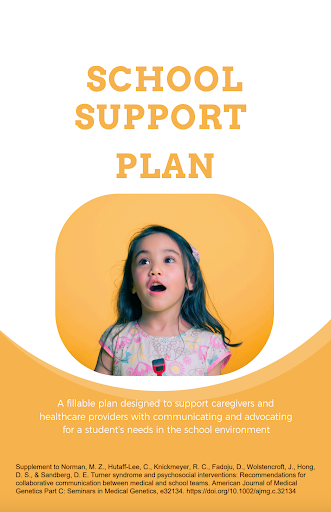
Effective coordination requires defined roles, timely communication, and shared language. In addition, tools like the Turner Syndrome School Support Plan are useful in creating this connection. Creating consistency for the student fosters a feeling of safety and support.
Practical Strategies for Families and Educators
For families:
- Don’t wait for the school to ask—proactively share information about TS and how it affects your child. The TSF website is full of a wealth of resources and webinars about the psychosocial impact of TS.
- Use resources like the Turner Syndrome School Support Plan to guide conversations.
- Encourage your healthcare team to connect with the school psychologist or nurse.
For educators:
- Invite families to share relevant health history at intake or IEP meetings.
- Offer to coordinate with medical providers, especially when implementing accommodations.
- Refer students with TS for counseling, social groups, or observation when you notice signs of anxiety or peer difficulty.
For providers:
- Consider developing brief letters or summaries explaining the impact of TS on learning and social development.
- Review the Turner Syndrome School Support Plan with families and help complete it if appropriate.
- Validate family concerns about school challenges and offer suggestions for follow-up support.
School-Based Interventions
In addition to the strategies listed above, there are proven, evidence-based school interventions that can make a lasting difference. Nearly every child attends school. This makes schools an ideal setting for early identification, intervention, and reinforcement of new skills. Especially when it comes to social anxiety and social skills development, schools are well-positioned to create real-time, real-world learning environments.
Group-based interventions are especially effective for girls with TS because students can practice conversations and peer interactions, receive feedback in the moment, and rehearse and generalize skills in natural environments like lunch, class discussions, or group projects.
Two Evidence-Based School Programs
1. PEERS® for the School Setting
Originally developed for adolescents with autism, PEERS (Program for the Education and Enrichment of Relational Skills) teaches:
- Conversational skills
- Peer entry and exit strategies
- How to use appropriate humor
- Navigating teasing, bullying, and rumors
- Handling rejection and building friendships
Studies have shown that students who participated in PEERS showed improved social motivation and communication, decreased autistic mannerisms, more frequent get-togethers with friends, and increased self-reported confidence in navigating peer relationships. These results were both self-reported and teachers also validated these improvements.
For girls with TS, this kind of structured program can be adapted to address their unique cognitive and social profiles, offering a safe and consistent space to build key relational skills.
2. SASS: Skills for Social and Academic Success
SASS is another highly structured intervention, originally developed for high school students with social anxiety disorder. It includes weekly group sessions, weekend social events with peer models, one-on-one student check-ins, and optional parent and teacher meetings.
SASS teaches:
- The CBT triangle (how thoughts, feelings, and behaviors connect)
- Relaxation techniques
- Gradual exposure to feared situations
- Initiating and maintaining conversations
Studies have shown SASS to reduce anxiety when delivered by school counselors and psychologists, including sustained improvements at follow-up sessions.
Relevance for Turner Syndrome
While these interventions weren’t developed specifically for Turner syndrome, they address the exact areas where many girls with TS struggle such as reading and interpreting social cues, building and maintaining friendships, managing anxiety in social situations, and navigating unstructured peer settings like lunch, recess, or group projects.
Building Bridges, Increasing Confidence

Coordinating care for girls with TS is not just possible, it’s essential. With tools like the Turner Syndrome School Support Plan, evidence-based school interventions, and a commitment to collaboration, we can build a system that works for the whole child.
For girls with Turner syndrome, especially those who may not qualify for IEPs or visible classroom support, these interventions can offer a lifeline of encouragement, growth, and genuine peer connection.
To learn more about this topic, view the recording of the webinar: Psychosocial & Educational Considerations for Turner Syndrome presented by Mackenzie Norman, PhD.
Sources
Research Brief: Addressing the Needs of Students with Chronic Conditions – CDC. Accessed 17 July 2025.
Moulton, E., & Laugeson, E. (2020). The Program for the Education and Enrichment of Relational Skills (PEERS). In D. W. Nangle, C. A. Erdley, & R. A. Schwartz-Mette (Eds.), Social skills across the life span: Theory, assessment, and intervention (pp. 255–273). Elsevier Academic Press. https://doi.org/10.1016/B978-0-12-817752-5.00013-5
Fisher, Paige H et al. “Skills for social and academic success: a school-based intervention for social anxiety disorder in adolescents.” Clinical child and family psychology review vol. 7,4 (2004): 241-9. doi:10.1007/s10567-004-6088-7
Written with information presented in the webinar, Psychosocial & Educational Considerations in Turner Syndrome presented by Mackenzie Norman, PhD, Psychologist Resident in Integrated Primary Care and Behavioral Pediatrics at Oregon Health & Science University. Designed by Delvis Rodriguez, Digital Marketing Coordinator
© Turner Syndrome Foundation, 2025