




Did you know that women with Turner Syndrome (TS) consistently attain academic success and are more likely to professionalize? (Goud et al., 2013). Those with TS often choose fields that positively impact society, such as healthcare, legal, community, and social services. They tend to be happier with their incomes as well (Noordman et al., 2021). That being said, research suggests they might have to fight harder to hold onto their positions (Cragg, 2018). However, studies also show that people with TS overcome many obstacles to achieve their career goals (Lin et al., 2019). And we want to encourage you to be that very individual.

This article is dedicated to providing tips and tools to inspire and ease your transition into the professional world. As a woman with TS who is a part of the labor market, I have come to face some of those stumbling blocks firsthand.
Keep reading to know how!
I would like to draw your attention to the boxes scattered throughout the article like this one! They provide real-world tips from my own experiences, which I hope will help you in your own circumstances or provide general insight.
Turning Challenges into (Daily) Triumphs
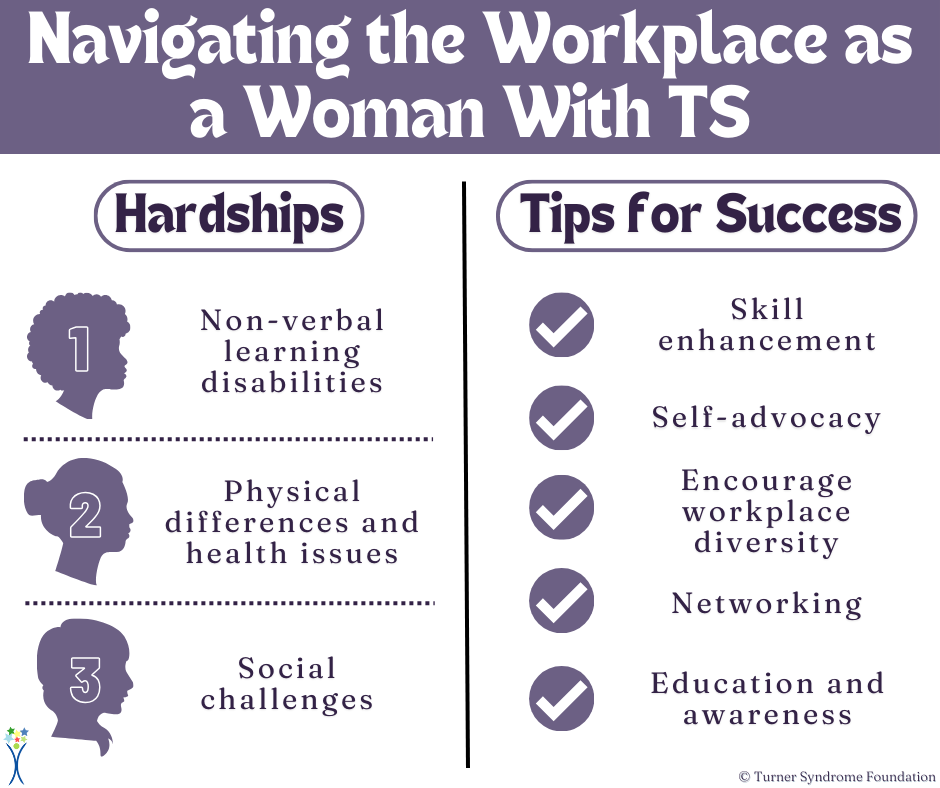
Seeking employment can be a daunting journey for anyone, especially for those new to the workforce. But for those with TS, the challenges go beyond the usual job market hurdles. Some examples of such barriers include:
1. Nonverbal Learning Disabilities (NVLD): Individuals with TS may experience nonverbal learning disabilities such as dyscalculia (impairment of mathematical ability due to an organic condition of the brain) and dysgraphia (impairment of handwriting ability that is characterized chiefly by very poor or often illegible writing or writing that takes an unusually long time and great effort to complete), making certain work tasks more challenging (Merriam-Webster). This may require additional support and accommodations in the workplace.
TSF offers more information on NVLD here.
Despite having dyscalculia, I was keen on progressing with my duties as a store clerk. So I asked to be taught how the cash register worked. It did not take long for me to realize that this was going to be my hardest challenge. But I had a couple of sessions with my trainee, in which she kindly solved all my doubts and concerns.
2. Physical Differences and Health Issues: TS often brings physical differences, including short stature. Health issues associated with TS may require medical attention and understanding from employers.
At my job, certain racks were too high that I couldn’t reach them. So I exposed my need for easier access. In my case, folding stairs were made available.
On the other hand, my main health issue is hearing loss. Realizing that the loud background music hindered my communication with customers, I asked for it to be turned down a notch during my shifts. This worked wonders for me so that I can better help the customers.
3. Social Challenges: The Turner Syndrome Support Society’s employment leaflet highlights the following social challenges faced by women with TS:
- Lack of intuition: Difficulty in interpreting body language and facial cues may cause occasional stubbornness.
- Low self-esteem: TS can propagate low confidence hindering one’s productivity.
- Team dynamics: Communication difficulties, influenced by hearing issues and low self-esteem, may make participation in teams or social gatherings challenging.
Additionally, individuals with TS may encounter rude or ignorant remarks from colleagues or customers, furthering esteem and team dynamic issues.
My colleagues used to complain about me “ignoring them”; now everyone reaches out to me because they know that I frequently rely on lip-reading.
I began by instructing my manager and colleagues to always ensure I’m making direct eye contact before addressing me. This indicates that I’ve noticed that I’m being spoken to. Otherwise, a light touch on the shoulder is a fantastic way to catch my attention.
This shows how crucial communication is.
The moral of the story is communication is absolutely vital to establish and maintain with your coworkers and supervisors. More often than not, your needs can be accommodated and you shouldn’t hesitate to ask for what you need to allow you to perform better.
Tips and Tools for Success
Now that you know that many difficulties with TS can be accommodated for, here’s a quick summary of tips and tools to ensure confidence in the workforce:
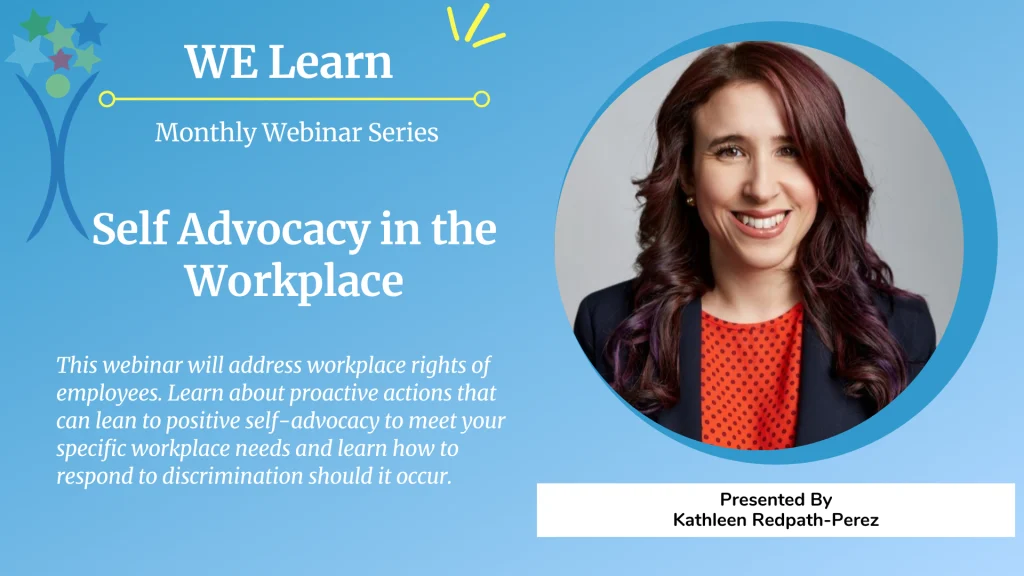
- Self-Advocacy: Learn to communicate your needs effectively, be it for workplace accommodations or understanding from colleagues. Don’t hesitate to seek support when necessary. Check this empowering webinar on self-advocacy in the workplace presented by Kathleen Redpath-Perez for more tips.
Skill Enhancement: Women with TS participating in a job satisfaction study reported being excluded from urgent, complex decisions and having fewer employment training opportunities than their peers (Gould et al., 2013). In addition, they also shared facing challenges in areas such as multitasking, managing finances, and interpersonal requirements.
If this sounds like you, do not despair. Focus on honing your unique strengths and skills. Embrace your unique qualities and use them to succeed in your chosen field, at your own pace and in your own way.
Think about your strengths! What is something that only you can bring to the table? I excel at language learning and text composition, so I am always glad to help clients from other countries and edit corporate emails, for instance.
3. Networking: Build a strong professional network to help you navigate the challenges. Connect with mentors who can offer guidance and support you in your career.
4. Embrace Diversity: Encourage workplaces to embrace diversity and inclusivity. Your unique perspective and experiences can be assets to any team. Redpath-Perez also offered a webinar on workplace rights that might come in handy, especially if you’re based in the USA.
5. Education and Awareness: Take the initiative to educate your colleagues and superiors about Turner syndrome. Creating awareness can foster understanding and empathy.
Overachievement and Mental Health

Finally, a word on mental health.
Research suggests that women with TS tend to display people-pleasing tendencies (Lin et al., 2019). We often become overachievers in various aspects of our lives, trying to “compensate” for what we feel we lack. However, it’s important to note that high achievement can also be a coping mechanism, especially in response to health-related traumas that we may have experienced.
While we aspire to become as successful as Missy Marlowe, Cynthia Nixon, Bella Hadid, Shauna Duggins, or Rosalind Franklin, we must acknowledge that constantly trying to prove ourselves can be exhausting. For this reason, it’s crucial to prioritize our mental health; if you ever feel “not worthy enough,” please seek professional help immediately. A specialist will help you unpack and process such feelings, reminding you that you are strong, capable, and definitely loved.
Resources:
Chadwick, P., Lee, M., Smyth, A., Chadwick, P., Liao, L. M., Croft, C., Armytage, J. G., Cleaver, H., & Rogers, P. (2011). Employment. Turner Syndrome Support Society. https://tss.org.uk/publications/EMPLOYMENT%20MASTER%20TSSS.pdf
Cragg, S. (2018). Perceived Social Capital of Women with Turner Syndrome (Master’s thesis, University of Windsor (Canada)).
Gould, H. N., Bakalov, V. K., Tankersley, C., & Bondy, C. A. (2013). High levels of education and employment among women with Turner syndrome. Journal of women’s health (2002), 22(3), 230–235. https://doi.org/10.1089/jwh.2012.3931
Merriam-Webster. (n.d.). Dyscalculia. In Merriam-Webster.com medical dictionary. Retrieved August 1, 2024, from https://www.merriam-webster.com/medical/dyscalculia
Merriam-Webster. (n.d.). Dysgraphia. In Merriam-Webster.com dictionary. Retrieved August 1, 2024, from https://www.merriam-webster.com/dictionary/dysgraphia
Noordman, I. D., van der Velden, J. A., Timmers, H. J., Reisch, N., Richter-Unruh, A., Pienkowksi, C., … & Claahsen-van der Grinten, H. L. (2021). Socioeconomic status in patients with Turner syndrome. Comprehensive Psychoneuroendocrinology, 5, 100030.
Lin, A. E., Prakash, S. K., Andersen, N. H., Viuff, M. H., Levitsky, L. L., Rivera‐Davila, M., … & Gravholt, C. H. (2019). Recognition and management of adults with Turner syndrome: from the transition of adolescence through the senior years. American Journal of Medical Genetics Part A, 179(10), 1987-2033.
Turner Syndrome. (n.d.). careersportal.ie. Retrieved August 4, 2024, from https://careersportal.ie/disability/az.php?sub_sector=57&parent=20&ed_sub_cat_id=90&menu_parent_id=
Learn About Self-Advocacy in the Workplace
FREE on-demand webinar available right at your fingertips!
Help us provide more free educational webinars for you by donating as little as a dollar.
Your support helps us support you!
Written by Andrea Pardo Salvador, TSF volunteer blog writer. Edited and Designed by Riya Ajmera. Cover Photo by Kesha Amin, Volunteer TSF Graphic Designer.
© Turner Syndrome Foundation, 2024