



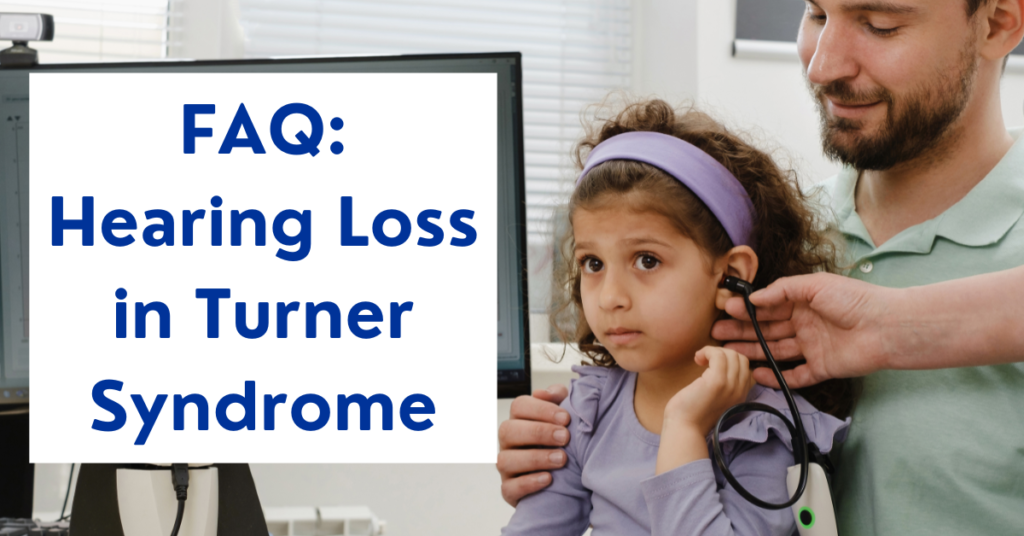
Individuals with Turner syndrome (TS) are more prone to hearing loss due to both structural and inner ear issues. In childhood, differences in skull and throat structure can lead to frequent middle ear infections (otitis media), causing conductive hearing loss. As they age, many develop sensorineural hearing loss due to inner ear or auditory nerve damage. This type worsens over time and affects up to 90% of adults with TS. While middle ear infections may decrease with age, ongoing hearing monitoring is essential throughout life.
Read a series of frequently asked questions to better understand hearing loss with TS
How is hearing loss measured?
In order to have a better understanding of hearing loss, it is important to understand the metric that is used to measure hearing. The decibel is a unit that measures how loud a sound is, and hearing loss is dependent on certain decibel ranges.
There are 5 general stages of hearing loss which includes mild, moderate, moderate to severe, severe, and profound hearing loss.
- The normal range of hearing is between 10 -15 decibels, so anything louder than this range can be considered hearing loss.
- If a person can hear within the 16-25 decibel range, then they are considered to have mild hearing loss.
- If sound amplification above 91 decibels is required, then the person is considered to have profound hearing loss.
The most common test used to check hearing is pure tone audiology where a sound is played at increasing decibel thresholds. Another test that can be used is a speech discrimination test which looks at the number of words that can be repeated. These methods allow audiologists and other health professionals who are trained to diagnose hearing loss accurately.
What are some hereditary causes of hearing loss?
Aside from changes with decibel ranges, hearing loss can be attributed to changes with the anatomy of the ear or associated nerves. This is differentiated by two terms: conductive or sensorineural hearing loss.
Within the scope of these categories, certain hereditary conditions, infections such as COVID, or traumas determine the specific cause and timing of when hearing loss presents. For example, According to the CDC, “1 out of 2 cases of hearing loss in babies is due to genetic causes…and 1 out of 3 babies with genetic hearing loss have a syndrome.”
In TS, there is sensorineural hearing loss which involves the inner ear, can start in childhood, but progresses during the 2nd and 3rd generations of life.
What are some action steps after noticing hearing loss?
If an individual develops hearing loss, it is important to see an audiologist who is trained to assess disorders of neuronal systems, hearing, and balance to correctly diagnose your condition. An Ear, Nose, and Throat (ENT) physician can also be seen, and they work together with other health professionals to ensure that proper treatment of symptoms is taken care of.
Some specific tests that are used to diagnose include the Auditory Brainstem Response (ABR) test which focuses on the function of the inner ear, as well as the Behavioral Audiometry Evaluation which tests how a person responds to overall sound. Once a diagnosis has been made, there are some recommendations that will be made which can include use of devices such as hearing aids.
What devices can be used to help with hearing loss?
Utilizing devices to aid in hearing is dependent on each individual. Hearing aids are made available over the counter (OTC), and dependent on the severity of hearing impairment, a hearing aid can also be prescribed for everyday use. The cost can range from as low as $800 upwards to $2000, so it is important to check if insurance, such as Medicaid, can provide some coverage. There are some programs such as AARP, which can offer 20% off hearing aids, and other programs online geared towards children, veterans and more, that can help with the financial burden of these devices.
In addition to hearing aids, cochlear implants which require surgical placement can also be explored. Prior to deciding if you would like to utilize an OTC hearing aid, it is best to consult with an audiologist who can recommend the best cost effective brands to use. Some other devices that some individuals use are portable sound or telephone amplifiers, flashing/vibrating alarms, to help with communication.
How did COVID impact patients with hearing impairment?
During the COVID-19 pandemic, communication for individuals with hearing impairments greatly suffered. Some ways that people with hearing loss use to communicate on a daily basis includes reading lips, looking at body language, and utilizing American Sign Language (ASL). With the rapid spread of COVID-19 during the height of the pandemic in 2020-2021, it became increasingly difficult to relay important medical information to many patients with hearing loss because of wearing masks and social distancing.
Aside from this, with rapidly changing information, some patients reported not being able to fully trust information that was online, or not having access to information in their respective ASL language. Some of the ways that medical professionals were encouraged then and still implement today to better help patients with hearing loss, includes rephrasing information if not properly relayed the first time, utilizing pen and paper to write down information, talking louder, and reducing background noise when necessary.
Everyday life and education
Each state provides an Early Hearing Detection and Intervention (EHDI) program in order to provide supportive services to families who have children with hearing loss. Through Infanthearing.org, a family can contact a local representative from each respective state for information on local educational programs.
For children that are in school, there are certain accommodations that are needed to provide an efficient learning environment, so an IEA/504 checklist can be given to a school or workplace environment. Some arrangements in the 504 plan include extra time for understanding, speech recognition appliances, flashing alarms, and much more. In the workplace, certain accommodations are also set in stone such as visual emergency notifications, video relay services, live interpreters, and closed captioning for videos.
There are a multitude of focus groups and online communities which include people with hearing impairments, so no individual should feel like they are alone when managing hearing loss.

THE 1938 COLLECTIVE IS MORE THAN A GIVING PROGRAM — IT’S A CIRCLE OF BELIEVERS STANDING FOR TURNER SYNDROME. YOUR GIFT OF ANY AMOUNT ENSURES THAT WE CAN CONTINUE TO HELP ALL PEOPLE.
🌟 JOIN US IN CHANGING LIVES EVERY SINGLE MONTH.
BECOME A MONTHLY MEMBER
Written by Chioma Gabriel and designed by Gerely Caba.
© Turner Syndrome Foundation, 2025