




October: Breast Cancer Awareness Month
Annually, the month of October marks Breast Cancer Awareness Month, which aims to educate and raise awareness about breast cancer. This article will detail an overview of breast cancer and its causes, symptoms, and the unique relationship between the genetic abnormalities characteristic of Turner syndrome and breast cancer risk.
What is Breast Cancer?
Breast cancer, one of the most common cancers in biological women, is the growth of cancerous breast cells into tumors that may metastasize, or spread, to other areas of the body (Breast Cancer, 2024a). The most common types of breast cancer are invasive ductal carcinoma (starts in milk ducts), lobular breast cancer (starts in milk producing ducts), and ductal carcinoma in situ (starts in milk ducts but does not spread beyond them) (Breast Cancer, 2024a). Breast cancer can also originate in blood and lymph vessels throughout breast tissue (What Is Breast Cancer?, n.d.-b). It can metastasize through blood or lymph vessels, which drain into nearby lymph nodes under the arm, near the chest, or under the collarbone (What Is Breast Cancer?, n.d.-b).
Breast cancer is treatable through surgery, chemotherapy, radiation therapy, immunotherapy, and hormone therapy, among other treatments (Breast Cancer, 2024a). Thanks to decades of innovation in treatment and detection methods, early stage breast cancer can almost always be fully eradicated.
Symptoms to Look Out For
Certain symptoms that you should have checked by a physician include:
- Lumps or pain in the breast and underarm
- Thickening and swelling of the breast and underarm
- Irritation or dimpling of breast skin
- Redness, pain, or flaky skin in the nipple area of the breast
- Nipple discharge other than milk, including blood
- Change in size or shape of breast
(Symptoms of Breast Cancer, 2024)
Risk Factors for Breast Cancer
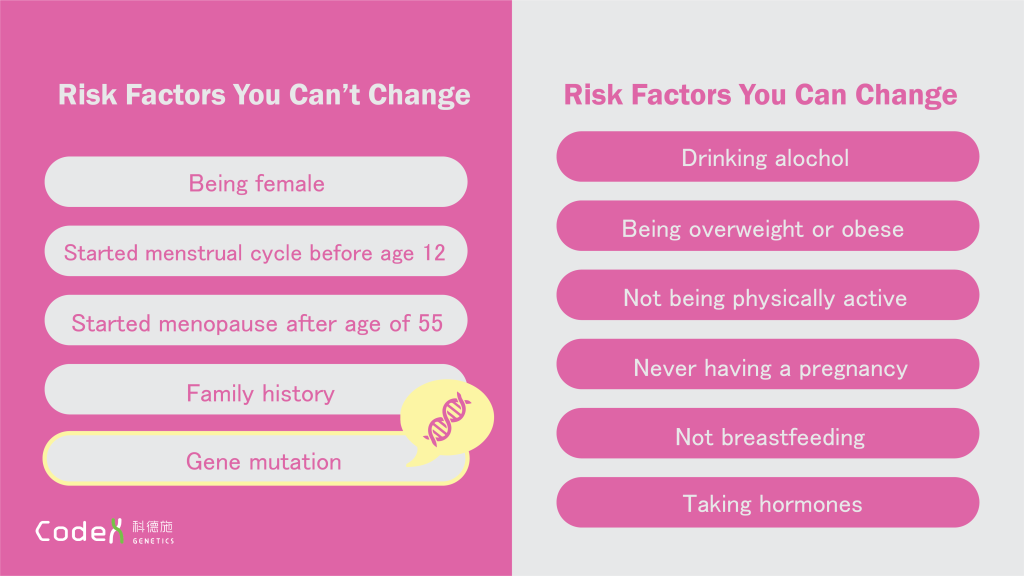
There are several lifestyle risk factors for breast cancer. They include:
- Alcohol consumption
- Obesity
- Lack of physical activity
- No pregnancy prior to age thirty
- Not breastfeeding
- Oral, shot, or implant birth control
- Menopausal hormonal therapy (specifically estrogen replacement)
(Lifestyle-related Breast Cancer Risk Factors, n.d.)
There are also risk factors for breast cancer that one is born with and cannot change. These include:
- Being born female
- Being over age 50
- Family history
- Race and ethnicity (white women overall have a higher risk, but African American women have a higher risk under age 40).
- Dense breast tissue
- Certain benign breast conditions
- Proliferative lesions without atypia (cell abnormalities) including usual ductal hyperplasia, fibroadenoma, sclerosing adenosis, papillomas, and radial scar
- Proliferative lesions with atypia including atypical ductal hyperplasia and atypical lobular hyperplasia.
- Lobular carcinoma in situ (cells that look like cancer cells in the lobules of milk producing glands).
(Breast Cancer Risk Factors You Can’t Change, n.d.)
The Genetics of Breast Cancer
Up to 10% of all breast cancers are caused by the BRCA1 and BRA2 gene mutations, which normally regulate the growth of breast, ovarian, and other cells (Breastcancer.org, 2024). Other high risk mutations include PALB2, PTEN, and TP53, and moderate risk mutations include ATM and CDH1 (Breastcancer.org, 2024).
When patients have a family history of breast, ovarian, and other cancers, it is recommended that they get genetic testing to determine if they have inherited one of these mutations (Genetic Testing for Hereditary Breast and Ovarian Cancer, 2024). While Turner syndrome patients usually undergo genetic testing as part of their diagnosis, these genes are not detectable on the test, which is most often karyotyping. Since karyotyping only displays the number and distribution of chromosomes, it cannot indicate specific gene mutations.
Turner Syndrome and Breast Cancer Risk
In a study of over 3,000 Turner syndrome patients, researchers found that they demonstrated a significantly decreased risk for breast cancer when compared with non-Turner syndrome individuals (Schoemaker et al., 2008). The Turner syndrome patients demonstrated half the predicted incidence rate, which had been calculated based on their personal risk factors and patient histories (Schoemaker et al., 2008). The type of Turner syndrome, mosaic versus monosomy X, did not change the reduced risk (Schoemaker et al., 2008). This decreased risk in Turner syndrome patients is theorized to be a result of underdeveloped breast tissue and low estrogen (Schoemaker et al., 2008).
Breast Cancer Risk Due to Hormone Therapy
Many Turner syndrome patients also undergo hormone replacement therapy to supplement their low estrogen levels. In non-Turner syndrome individuals, estrogen-based hormone therapies, usually used for the treatment of menopause symptoms, is well established to increase breast cancer risk. However, in Turner syndrome patients who had undergone various hormone replacement therapies for two to four decades of their lives displayed no increased risk for breast cancer (Schoemaker et al., 2008).
This is likely because the estrogen replacement only raises their estrogen levels to normal, so there is no surplus of estrogen to potentially cause breast cancer.
Key Takeaways
- Breast cancer is the growth of cancerous tumors in breast tissue, often originating from milk glands or ducts.
- Genetic testing for genes that indicate a predisposition to breast cancer must be done separately from Turner syndrome testing, as it requires a more specific kind of test.
- Turner syndrome patients, regardless of the mutation they possess, demonstrate a significantly lower risk for breast cancer than the general population, even when undergoing hormone replacement therapy.
- If you have a family history of breast, ovarian, or other cancers, it is highly recommended to undergo genetic testing for the high-risk mutations and be regularly screened for signs of cancer, as even a reduced risk is still a risk.
- All women over the age of 40, regardless of if they have Turner syndrome or not, should talk to their doctor about a mammogram, as breast cancer treatments are most effective when the cancer is caught early.


References:
Bösze, P., Tóth, A., & Török, M. (2006). Hormone replacement and the risk of breast cancer in Turner’s syndrome. New England Journal of Medicine, 355(24), 2599–2600. https://doi.org/10.1056/nejmc062795
Breast cancer. (2024a, September 9). Cleveland Clinic. https://my.clevelandclinic.org/health/diseases/3986-breast-cancer
Breast cancer. (2024b, September 9). Cleveland Clinic. https://my.clevelandclinic.org/health/diseases/3986-breast-cancer
Breast cancer risk factors you can’t change. (n.d.). American Cancer Society. https://www.cancer.org/cancer/types/breast-cancer/risk-and-prevention/breast-cancer-risk-factors-you-cannot-change.html
Breastcancer.org. (2024, March 9). Genetics. https://www.breastcancer.org/risk/risk-factors/genetics#
Genetic testing for hereditary breast and ovarian cancer. (2024, August 27). Hereditary Breast and Ovarian Cancer. https://www.cdc.gov/breast-ovarian-cancer-hereditary/testing/index.html#:~:text=Genetic%20testing%20is%20done%20with,to%20get%20the%20test%20results
Lifestyle-related breast cancer risk factors. (n.d.). American Cancer Society. https://www.cancer.org/cancer/types/breast-cancer/risk-and-prevention/lifestyle-related-breast-cancer-risk-factors.html
Schoemaker, M. J., Swerdlow, A. J., Higgins, C. D., Wright, A. F., & Jacobs, P. A. (2008). Cancer incidence in women with Turner syndrome in Great Britain: a national cohort study. The Lancet Oncology, 9(3), 239–246. https://doi.org/10.1016/s1470-2045(08)70033-0
Symptoms of breast cancer. (2024, September 25). Breast Cancer. https://www.cdc.gov/breast-cancer/symptoms/index.html
What is breast cancer? (n.d.-a). American Cancer Society. https://www.cancer.org/cancer/types/breast-cancer/about/what-is-breast-cancer.html
What is breast cancer? (n.d.-b). American Cancer Society. https://www.cancer.org/cancer/types/breast-cancer/about/what-is-breast-cancer.html
Written by Nadia Kim, TSF volunteer blog writer. Edited and Designed by Riya Ajmera, TSF Blog Coordinator. Cover Graphic by Kesha Amin, TSF volunteer graphic designer. Peer Reviewed by Mary Gwyn Roper, MD and Kayla Ganger, PA-C.
© Turner Syndrome Foundation, 2024

My husband just went through breast cancer he had a mastectomy removed pectoral muscle and is still healing it was stage 2 cancer and a pound. He is now in recovery. No.signs of comming back yet.