The skeleton provides mechanical support for an individuals structure and movement, protects vital organs, and controls mineral homeostasis. A healthy skeleton must be maintained by constant bone modeling to carry out these crucial functions throughout life. Bone remodeling involves the removal of old or damaged bone by bone resorption and the subsequent replacement of new bone formed by bone formation. Normal bone remodeling requires a tight coupling of bone resorption to bone formation to guarantee no alteration in bone mass or quality after each remodeling cycle.
HEALTHY BONES
HEALTHY BODY
Orthopedic Evaluation
Infants with TS have an increased risk of congenital hip dislocation, which may be associated with degenerative arthritis of the hips in older women. Approximately 10% of girls with TS develop scoliosis, most commonly during adolescence.
Common Bone Issues
Wide short neck
Broad chest
Square torso
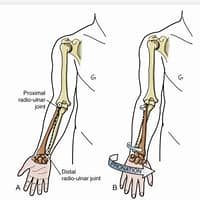
Cubitus valgus, a deformity of outward turned arms
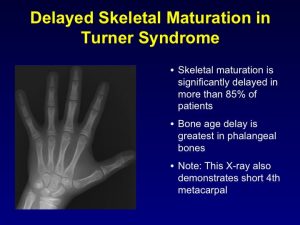
Malformation of fingers (short 4th and 5th metacarpals)
Congenital developmental dysplasia of the hip occurs more frequently in girls with Turner syndrome than in the general population. This contributes to the development of arthritis of the hips in older individuals. Girls with Turner syndrome also have an increased risk of scoliosis, over curviture of the over-curvature of the thoracic vertebrae, or swayback an overexagerated curve in the lower spine.
Orthodontic Issues
The small and retrognathic mandible may contribute to malocclusion and other dental abnormalities. An orthodontic examination should therefore be undertaken at 8–10 yr of age.
If craniofacial anomalies cause concern, consider plastic surgery for the neck, face, or ears before the child enters school or thereafter, as indicated. Some individuals with Turner syndrome have a tendency to form keloids, which must be taken into account when surgery is considered.
Fractures
Young women with Turner syndrome did not incur fractures more frequently than those without the disease; however, fracture location differed between the two groups, according to study results. Halley M. Wasserman, MD, assistant professor at Cincinnati Children’s Medical Center… Read more
In a 2019 publication, ‘Fracture rate in women with oestrogen deficiency – Comparison of Turner Syndrome and premature ovarian insufficiency, a EU study concluded that TS is not associated with an overall excess risk of bone fracture. The higher rate of fractures at major osteoporotic fracture sites may be secondary to other issues such as hearing impairment and thinning or abnormal bone remodeling. Bone remodeling is the natural process of cyclical rebuilding of bone structure. Read more
Osteoporosis
There is a high incidence of osteoporosis—meaning thin or weak bones—in women with Turner syndrome. Osteoporosis leads to loss of height, curvature of the spine and increased bone fractures.
Frequently Asked Questions (FAQ’s) are commonly asked questions asking for more information to support this subject. The answers to the questions are provided by professionals to assist you in sourcing accurate information. Every individual requires specialized care. Always refer to your medical provider for individualized care.