



Kidneys

From filtering waste and toxins to regulating blood pressure and producing vital hormones, the kidneys are essential to the body’s functioning (Cleveland Clinic, n.d.a). This page will offer insight into how Turner syndrome can influence kidney development and functioning. It will also detail the necessity to monitor urological symptoms, and describe diagnosis and treatment procedures that are available.
Kidney Anatomy
When the kidneys develop without any abnormalities, they are two separate organs that are situated just beneath the ribcage and nestled behind the stomach organ (Cleveland Clinic, n.d.a). One kidney is on the left side of the spine, and another is on the right. Each kidney is connected to your bladder by a ureter.
Kidney Abnormalities
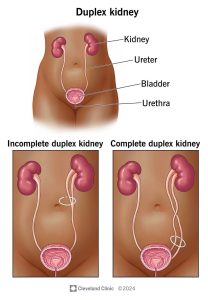
Some anatomical abnormalities observed in women who have Turner syndrome include duplex collecting systems, horseshoe kidney, absence of a kidney on one side, and crossed ectopia (Lippe et al.,1988).
Duplex Collecting System
The kidneys do not form correctly, and there are two drainage pathways from the kidney when there should only be one (Cleveland Clinic, n.d.b).
However, the diagnosis can be delayed until adulthood. This happens when only the symptoms of duplex collecting systems, such as urinary tract infections (UTIs) and kidney infections are treated. If the underlying structural cause is not investigated, the condition may go undiagnosed until later in life (Cleveland Clinic, n.d.b).
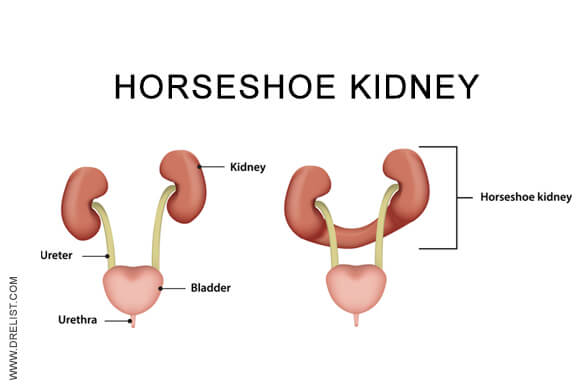
Horseshoe Kidney Anatomy
When the kidneys are fused together in their normal position in the body in the form a “U” shape (Boston Children’s Hospital, n.d.). Having a horseshoe kidney can lead to several complications. A horseshoe kidney increases a person’s risk for kidney stones, hydronephrosis, kidney cancer, polycystic kidney disease, hydrocephalus (fluid buildup in the brain), and spina bifida (a spine problem) (Boston Children’s Hospital, n.d.).
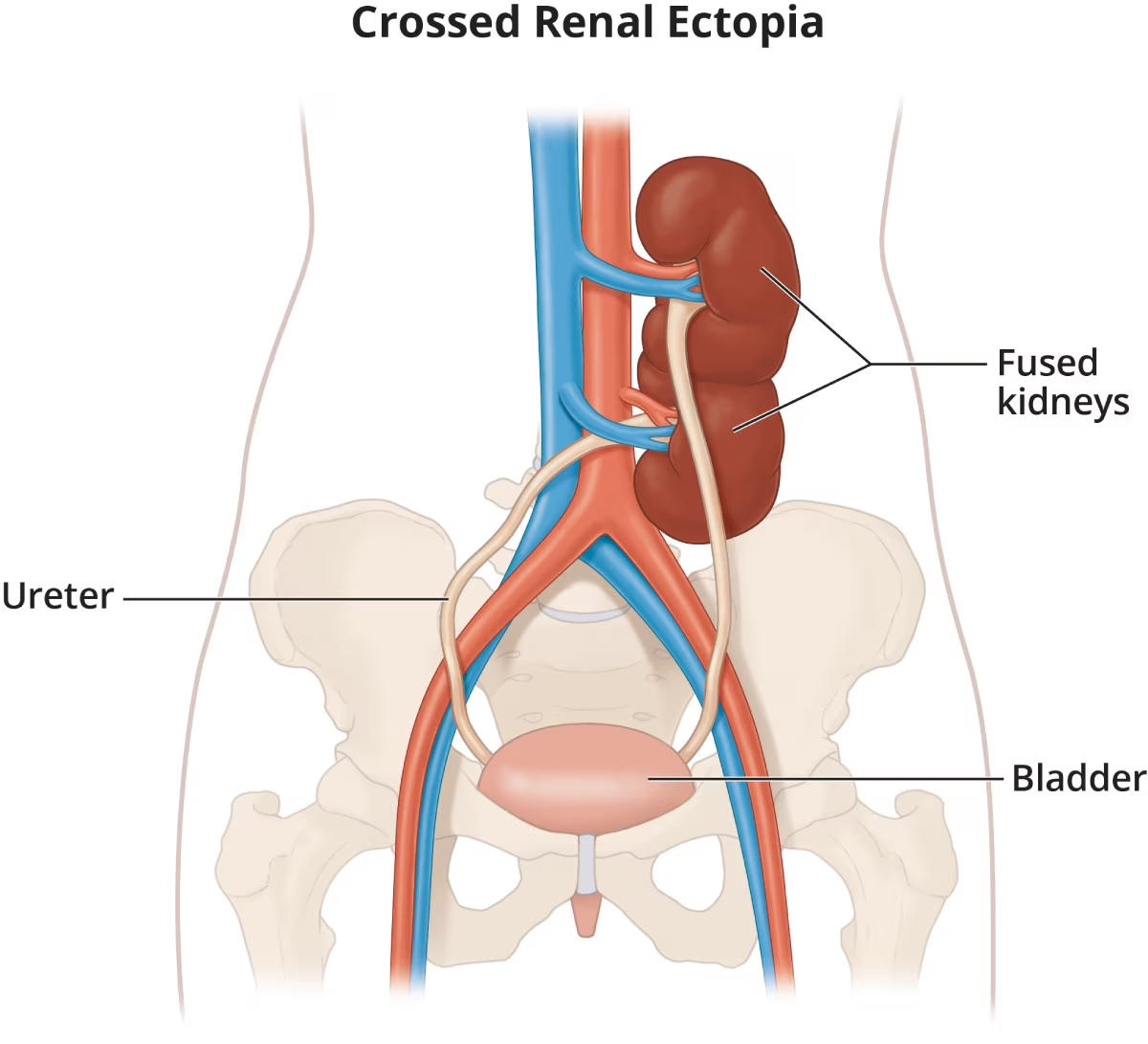
Crossed Ectopia Anatomy
When both kidneys are on the same side and may become fused to each other (Urology Care Foundation, n.d.a). Crossed ectopia can lead to vesicoureteral reflux (VUR), which is a backward flow of urine from the bladder through the ureters into the kidneys. VUR can result in infections, and over time lead to irreversible kidney damage (Urology Care Foundation, n.d.b).
Symptoms To Monitor
Many women will suffer from urinary tract infections (UTI) in their lifetime. However, women with Turner syndrome should monitor for urinary symptoms such as frequent UTI, urinary incontinence, kidney stones, and hydronephrosis that can indicate renal complications as well. Below are detailed explanations of the symptoms associated with these conditions:
Urinary Tract Infection
UTIs can feel like you need to pee all the time (urinary urgency) or have a burning sensation when you go (dysuria). The amount of urine is passed in small amounts, and it may be cloudy or reddish and have an off smell (Mayo Foundation for Medical Education and Research, 2022b). (Note that some may not experience these common symptoms). Frequent UTIs should be brought to the attention of your medical provider.
Urinary Incontinence
Many people believe urinary incontinence is when a large amount of urine escapes the bladder without their control. While this may be the case for some people, small to moderate amounts of urine loss without control is also incontinence. This can present as losing small amounts of urine after coughing, sneezing, laughing, exercising, or lifting heavy objects (Mayo Foundation for Medical Education and Research, 2023). Urinary incontinence can also present as continuous dribbling of urine due to incomplete bladder emptying (Mayo Foundation for Medical Education and Research, 2023).
Kidney Stones
Causes sharp intense pain in a person’s side and back area (known as the flank area). The pain often fluctuates in intensity and comes in waves (Mayo Foundation for Medical Education and Research, 2022a). Additional symptoms of kidney stones can include discomfort or burning sensations during urination, alongside signs such as pink, red, or brown urine, cloudy or malodorous urine, frequent urination, nausea, vomiting, fever, and chills.
Hydronephrosis
Occurs when there is a urinary tract obstruction and the kidney(s) become enlarged and potentially damaged. Symptoms of hydronephrosis are uncommon, but may include abnormal swelling or lump in the abdominal area upon examination by a doctor, trouble gaining weight, decreased urination, and urinary tract infections (Cleveland Clinic, n.d.b).
If you or a loved one has any of the symptoms above occur, tell your doctor to have appropriate testing ordered to screen for renal abnormality. Read further to learn more about diagnosing and testing.
Diagnosis
To diagnose any of these conditions your doctor may order a variety of tests. Testing can help determine what potential anatomical condition could be present. Some doctors recommend an ultrasound to screen for renal abnormalities when Turner syndrome is first diagnosed. This recommendation is advised because some patients are asymptomatic (exhibit no symptoms) of their renal abnormalities, yet these abnormalities still pose a risk to their kidney health (Lippe et al.,1988). Early detection of some of these conditions can be crucial for treatment.
There are specific tests for the urinary systems that may be ordered:
Voiding cystourethrogram (VCUG) is a procedure where dye that can appear on an X-ray is inserted via catheter into the bladder. X-ray images are taken to observe if urine is flowing in the wrong direction back into the ureters and kidneys (Urology Care Foundation, n.d.b).
Intravenous pyelogram (IVP) is another imaging approach that utilizes X-rays to examine urinary tract structures. In an IVP, contrast dye is intravenously administered to enhance visibility of the flow rate and pathway of urine through the urinary system on X-ray images (Urology Care Foundation, n.d.b).
Treatment Options
Duplex collecting system malformation has several treatment options, although many people with this condition do not require treatment.
- Ureteroureterostomy is when the ectopic ureter (the ureter that is not draining to the bladder correctly) is surgically attached to the normally functioning ureter in the lower portion of the kidney. This enables proper drainage of urine from the kidney (Cleveland Clinic, n.d.b).
- Ureteral reimplantation is when the ectopic ureter is surgically attached to the bladder, ensuring proper urine drainage without backward flow. (Cleveland Clinic n.d.b).
- Nephrectomy involves surgical removal of some or all of the malfunctioning kidney. This is a last resort treatment that is only recommended when the impacted kidney function is severely impaired and the other kidney functions normally.
- Ureteroureterostomy is when the ectopic ureter (the ureter that is not draining to the bladder correctly) is surgically attached to the normally functioning ureter in the lower portion of the kidney. This enables proper drainage of urine from the kidney (Cleveland Clinic, n.d.b).
The goal in treatment of duplex collecting systems is to alleviate incontinence and reduce infection risk (Cleveland Clinic, n.d.b).
Horseshoe kidney treatment is about managing the symptoms if they arise. Treatment options may involve administering antibiotics to address underlying infections, as well as surgical and non-surgical options to treat kidney stones (Boston Children’s Hospital, n.d.).
Crossed ectopia treatment is only required if there is a blockage or if studies show urine reflux happening. If this is the case, and the kidney is not too damaged, surgery can be done to correct it. If the kidney is severely damaged and not functioning well the kidney may need to be removed (Urology Care Foundation, n.d.b).
Takeaway
If you or someone dear to you has Turner syndrome and has not undergone screening for kidney abnormalities, it’s crucial to do so to prevent potential complications. You are not alone in your struggles and deserve to be taken seriously. Seeing a nephrologist or urologist at a specialized center with expertise in the urological complications of Turner syndrome is the best way to receive complete and thorough care. If one of these providers isn’t accessible, it’s important to discuss these concerns with your primary care provider (PCP) and request a referral to a nephrologist or urologist who is knowledgeable about Turner Syndrome. When these renal abnormalities are detected early and appropriate actions are taken, most of these conditions can be managed without complication.
Additional Research
These white pages involve research that was conducted on patients with Turner syndrome that had various renal malformations.
References:
Boston Children’s Hospital. (n.d.). Horseshoe Kidney. Horseshoe Kidney Boston Children’s Hospital. https://www.childrenshospital.org/conditions/horseshoe-kidney
Cleveland Clinic. (n.d.-a). Kidneys. Cleveland Clinic. https://my.clevelandclinic.org/health/body/21824-kidney
Cleveland Clinic. (n.d.-b). What is Duplex Kidney (Duplicated Ureters). Cleveland Clinic. https://my.clevelandclinic.org/health/diseases/16492-duplex-kidney
Lippe B, Geffner ME, Dietrich RB, Boechat MI, Kangarloo H. Renal malformations in patients with Turner syndrome: imaging in 141 patients. Pediatrics. 1988 Dec;82(6):852-6. PMID: 3054787.
Mayo Foundation for Medical Education and Research. (2022, June 3-a). Kidney Stones. Mayo Clinic. https://www.mayoclinic.org/diseases-conditions/kidney-stones/symptoms-causes/syc-20355755
Mayo Foundation for Medical Education and Research. (2022, September 14-b). Urinary Tract Infection (UTI). Mayo Clinic. https://www.mayoclinic.org/diseases-conditions/urinary-tract-infection/symptoms-causes/syc-20353447
Mayo Foundation for Medical Education and Research. (2023, February). Urinary Incontinence. Mayo Clinic. https://www.mayoclinic.org/diseases-conditions/urinary-incontinence/symptoms-causes/syc-20352808
Urology Care Foundation. (n.d.-a). Ectopic Kidney. Urology Care Foundation. https://www.urologyhealth.org/urology-a-z/e/ectopic-kidney
Urology Care Foundation. (n.d.-b.). Vesicoureteral Reflux (VUR). Urology Care Foundation. https://www.urologyhealth.org/urology-a-z/v/vesicoureteral-reflux-(vur)
Written and Researched by Victoria Brown, TSF Blog Writer. Edited and Designed by Riya Ajmera, TSF Blog Coordinator. Peer Reviewed by Mary Gwyn Roper, MD and Kayla Ganger, PA-C.
© Turner Syndrome Foundation, 2024
